



Table of Content:
-
-
-
- Understanding Industrial Coding and Marking Systems
-
- Why Product Coding Is Essential
- Industries That Depend on Coding Machines
-
- Understanding Industrial Coding and Marking Systems
-
- What is a Continuous Inkjet (CIJ) Printer?
-
- How CIJ Technology Works
- Advantages and Limitations of CIJ
-
- What is a Continuous Inkjet (CIJ) Printer?
-
- What is a Thermal Inkjet (TIJ) Printer?
-
- How TIJ Printing Works
- Advantages and Limitations of TIJ
-
- What is a Thermal Inkjet (TIJ) Printer?
-
- What is a Thermal Transfer Overprinter (TTO)?
-
- Applications of TTO Printing
- Benefits and Drawbacks
-
- What is a Thermal Transfer Overprinter (TTO)?
-
- What is a Laser Coding Machine?
-
- Types of Laser Marking Technologies
- Benefits and Limitations
-
- What is a Laser Coding Machine?
-
- How to Choose the Right Coding Technology
- Final Verdict
- Frequently Asked Questions
-
-
CIJ vs TIJ vs TTO vs Laser Coding Machines: Which One is Right for Your Business?
Before investing in an industrial coding machine, every manufacturer faces the same question: Which coding and marking machine delivers the best performance, print quality, operating cost, and long-term value? Choosing the wrong industrial inkjet printer can lead to higher maintenance costs, production downtime, poor print quality, and compliance issues. Selecting the right industrial coding solution, on the other hand, improves productivity, enhances product traceability, and ensures regulatory compliance.
From food and beverage manufacturers to pharmaceutical companies, cosmetics brands, automotive suppliers, electronics manufacturers, and packaging industries, industrial coding and marking systems have become an essential part of every production line. Whether printing expiry date printing, batch coding, barcode printing, QR code printing, logos, serial numbers, or variable data, selecting the correct technology directly impacts manufacturing efficiency.
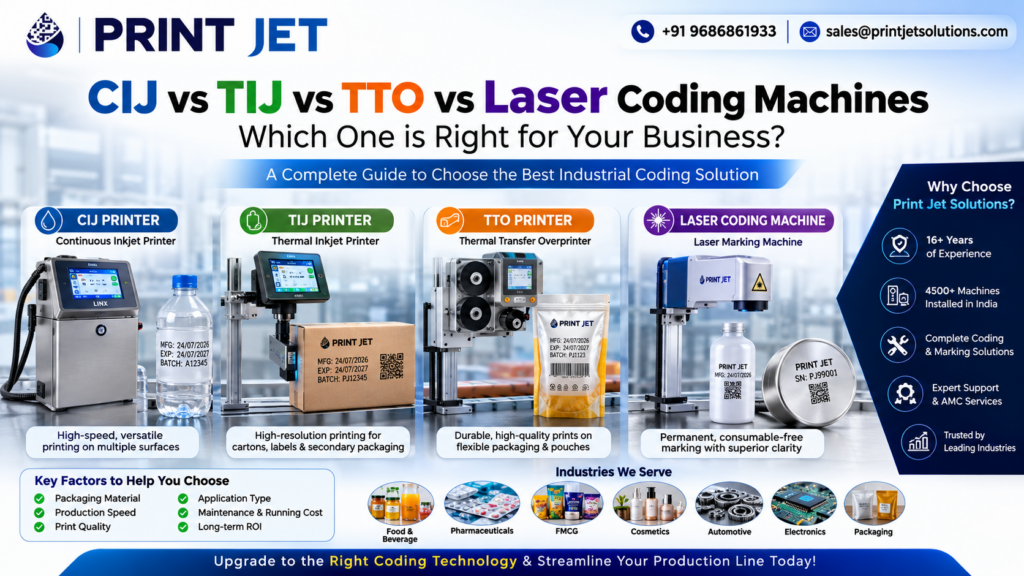
Understanding Industrial Coding and Marking Systems
Industrial coding and marking systems are no longer optional in modern manufacturing. Every packaged product reaching consumers today carries vital information such as manufacturing dates, expiry date printing, batch numbers, QR code printing, serial numbers, barcode printing, and regulatory markings. These codes improve product traceability, help manufacturers comply with industry regulations, simplify recalls, and increase consumer confidence. Whether a company produces food products, pharmaceutical medicines, cosmetics, automotive parts, cables, electronics, beverages, or industrial components, reliable product identification systems have become a necessity rather than a luxury.
The rapid adoption of Industry 4.0, automation, and smart manufacturing has further increased the importance of high-speed coding machines, accurate industrial marking systems, and permanent coding technologies. Manufacturers are expected to print thousands of products every hour without compromising print quality or production speed. This demand has led to the widespread use of four major technologies: Continuous Inkjet Printer (CIJ), Thermal Inkjet Printer (TIJ), Thermal Transfer Overprinter (TTO), and Laser Coding Machine. Each technology offers unique strengths, making it suitable for specific production environments and packaging materials. Understanding these differences is the first step toward making an informed investment.
Why Product Coding Is Essential
Product coding and marking go far beyond printing a simple expiry date. It enables complete product traceability across the supply chain, helping manufacturers track products from production to retail shelves. In regulated industries such as pharmaceuticals and food processing, accurate batch coding is legally required to ensure consumer safety and facilitate efficient product recalls if necessary. Modern industrial coding machines also support anti-counterfeiting measures by printing unique serial numbers, QR code printing, and Data Matrix codes that verify product authenticity.
Beyond compliance, coding and marking equipment enhances operational efficiency. Automated coding eliminates manual errors, reduces waste, improves production speed, and ensures every package carries consistent, legible information. Businesses adopting advanced industrial printing solutions often experience reduced downtime, lower maintenance costs, and improved overall productivity.
Industries That Depend on Coding Machines
Virtually every manufacturing sector relies on industrial coding machines. Food and beverage manufacturers use expiry date printers to print expiry dates and batch numbers on bottles, cartons, pouches, and cans. Pharmaceutical companies depend on high-resolution inkjet printers for regulatory compliance and patient safety. Cosmetics manufacturers print manufacturing details and branding information using industrial marking machines. Automotive companies mark components for traceability, while electronics manufacturers serialize products for inventory management and warranty tracking. Packaging companies, cable manufacturers, chemical industries, and logistics providers also utilize coding and marking solutions to streamline operations and improve product traceability throughout the supply chain.
What is a Continuous Inkjet (CIJ) Printer?
A Continuous Inkjet Printer (CIJ Printer) is one of the most widely used industrial coding machines in manufacturing due to its ability to print at extremely high production speeds. Unlike contact printing technologies, a Continuous Inkjet Printer uses a continuous stream of electrically charged ink droplets that are precisely directed onto the product surface to create characters, numbers, logos, barcodes, and variable data. Any unused ink is recirculated back into the system, making the process continuous and efficient. Because of its non-contact printing capability, CIJ technology can print on flat, curved, rough, uneven, or irregular surfaces without slowing down the production line.
One of the biggest advantages of a CIJ Printer is its versatility. It can print on a wide variety of materials, including plastic bottles, PET containers, glass, metal cans, aluminum, paper, cartons, wood, cables, pipes, flexible films, and even moving products traveling at very high speeds. This makes it the preferred industrial coding solution for industries such as food and beverages, pharmaceuticals, FMCG, automotive, cosmetics, chemicals, and building materials. Whether printing expiry date printing, batch coding, serial numbers, barcode printing, or QR code printing, a Continuous Inkjet Printer consistently delivers reliable performance across demanding manufacturing environments.
Another major benefit is its compatibility with numerous industrial inks. Manufacturers can choose from standard black inks, pigmented inks, food-grade inks, UV-readable inks, colored inks, and solvent-resistant formulations depending on the application. Modern industrial inkjet printers are also designed with intelligent software, touchscreen interfaces, remote monitoring, and predictive maintenance features that reduce downtime and improve operational efficiency. Although CIJ Printers require periodic maintenance and consumables such as ink and make-up fluid, they remain one of the most cost-effective coding and marking machines for high-volume production lines where speed and flexibility are critical.
How CIJ Technology Works
The working principle of a Continuous Inkjet Printer is based on the controlled formation of microscopic ink droplets. Inside the printer, ink is pressurized and forced through a tiny nozzle, creating a continuous stream of droplets. These droplets pass through a charging electrode where selected droplets receive an electrical charge. Deflection plates then guide the charged droplets toward the product while unused droplets are collected, filtered, and returned to the ink reservoir for reuse. This continuous cycle enables uninterrupted printing even at production speeds exceeding hundreds of meters per minute.
Because the droplets never physically touch the printhead, CIJ technology is highly reliable in dusty, humid, or harsh industrial environments. It also allows manufacturers to print on moving products without requiring perfect alignment. Whether products are transported on conveyors, rotary systems, or automated packaging lines, CIJ Printers maintain excellent print consistency. This capability has made Continuous Inkjet Printers the industry standard for high-speed coding machines used in beverage bottling plants, dairy processing facilities, pharmaceutical manufacturing, and FMCG production.
Advantages and Limitations of CIJ Printers
The popularity of Continuous Inkjet Printers comes from their ability to balance speed, reliability, and application flexibility. They can print on almost any material while maintaining high production throughput, making them ideal for 24/7 manufacturing environments. Businesses seeking a dependable industrial coding machine for variable data printing often choose CIJ because it integrates seamlessly into existing production lines.
Advantages of CIJ Printers
| Feature | Benefit |
| High-speed printing | Suitable for fast production lines exceeding hundreds of products per minute |
| Non-contact printing | Prints on curved, uneven, and irregular surfaces |
| Versatile substrate compatibility | Works on plastic, glass, metal, cartons, cables, films, and more |
| Excellent variable data printing | Ideal for batch coding, expiry date printing, serial numbers, and barcodes |
| Wide ink selection | Standard, pigmented, UV-readable, food-grade, and specialty inks available |
| Easy integration | Compatible with automated packaging and conveyor systems |
Despite these strengths, CIJ Printers also have a few considerations. Regular maintenance is required to keep the nozzles clean and ensure optimal print quality. The use of consumables such as ink and make-up fluid contributes to ongoing operating costs. Businesses should also factor in ventilation requirements when using solvent-based inks. Even with these considerations, the flexibility, speed, and reliability of Continuous Inkjet Printers make them one of the most widely adopted coding and marking solutions worldwide.
What is a Thermal Inkjet (TIJ) Printer?
A Thermal Inkjet Printer (TIJ Printer) is a modern industrial coding machine designed to deliver exceptionally high-resolution printing with minimal maintenance. Unlike Continuous Inkjet Printers, which rely on a continuous stream of ink, TIJ technology uses tiny heating elements inside disposable cartridges. These heating elements rapidly create microscopic bubbles that force ink droplets through precision nozzles onto the product surface. Because the printhead is integrated into each cartridge, every cartridge replacement effectively provides a new printhead, eliminating many maintenance challenges associated with traditional inkjet systems.
One of the greatest strengths of a Thermal Inkjet Printer is its superior print quality. It produces sharp text, crisp logos, high-resolution barcode printing, and clear QR code printing, making it ideal for industries that require premium product presentation. Pharmaceutical packaging, cosmetic cartons, food cartons, electronics packaging, and consumer goods frequently use TIJ Printers because customers and regulatory authorities demand highly legible product information. Businesses looking for an industrial inkjet printer that offers excellent print clarity while reducing maintenance costs often find TIJ technology to be the ideal solution.
Another reason for the growing popularity of Thermal Inkjet Printers is their simplicity. Installation is straightforward, cartridge replacement takes only a few seconds, and there is no need for complicated ink circulation systems or solvent management. Modern TIJ Printers support network connectivity, touchscreen controls, cloud-based monitoring, and seamless integration with automated production lines. While cartridge costs can be higher than bulk ink systems in very high-volume production, many businesses appreciate the clean operation, minimal downtime, and exceptional print quality that Thermal Inkjet Printers provide.
How TIJ Printing Works
The Thermal Inkjet Printer (TIJ Printer) operates using a highly precise thermal firing process that produces exceptionally sharp prints. Inside every ink cartridge are hundreds of microscopic nozzles, each equipped with a tiny resistor. When a print command is received, the resistor rapidly heats a small amount of ink to create a vapor bubble. The expanding bubble forces an accurately measured droplet of ink onto the product surface before collapsing almost instantly, allowing fresh ink to refill the chamber. This process happens thousands of times per second, enabling the printer to produce clean, consistent text, logos, barcode printing, QR code printing, and variable information with remarkable precision.
Unlike Continuous Inkjet Printers, TIJ technology does not require pumps, solvent circulation systems, or ink return mechanisms. Since each cartridge contains its own printhead, replacing the cartridge automatically replaces the critical printing components, reducing maintenance requirements significantly. This simple design minimizes production downtime and ensures consistent print quality throughout the cartridge’s life. Modern TIJ Printers also feature advanced controllers capable of storing thousands of print messages, supporting multiple printheads, and integrating with ERP systems, barcode scanners, vision inspection systems, and automated packaging lines. As a result, manufacturers benefit from an industrial coding solution that is easy to operate while delivering premium print quality.
Advantages and Limitations of TIJ Printers
The popularity of Thermal Inkjet Printers continues to grow because they combine outstanding print quality with low maintenance and user-friendly operation. Businesses that prioritize sharp graphics, clear product identification, and minimal operator intervention often select TIJ Printers over other coding and marking machines. They are particularly effective for printing on cartons, labels, coated paper, pharmaceutical boxes, and secondary packaging where high-resolution text and graphics are essential.
| Advantages | Benefits |
| High-resolution printing | Produces crisp text, logos, QR code printing, and barcode printing |
| Minimal maintenance | No ink circulation system or complex servicing required |
| Clean operation | No solvent management or messy ink refilling |
| Compact design | Easy integration into existing production lines |
| Quick cartridge replacement | Reduces downtime and simplifies maintenance |
| Excellent print consistency | Ideal for pharmaceutical, cosmetic, and FMCG packaging |
Despite these strengths, TIJ Printers also have some limitations. Printing costs can increase in high-volume production because cartridges must be replaced periodically. The printing distance between the printhead and the product is relatively small, requiring accurate product positioning. Certain highly porous or rough surfaces may also require specialized ink formulations to achieve optimal adhesion. Even with these considerations, Thermal Inkjet Printers remain one of the best industrial coding machines for manufacturers seeking superior print quality with minimal maintenance.
What is a Thermal Transfer Overprinter (TTO)?
A Thermal Transfer Overprinter (TTO Printer) is a specialized coding and marking machine designed primarily for printing on flexible packaging materials such as pouches, laminated films, sachets, labels, and plastic wraps. Unlike ink-based technologies, a TTO Printer uses a thermal printhead to transfer ink from a ribbon directly onto the packaging material. This process creates exceptionally durable, high-resolution prints that resist smudging, scratching, moisture, and abrasion. Because no liquid ink is involved, Thermal Transfer Overprinters provide clean and consistent printing without concerns about ink drying or nozzle clogging.
The increasing demand for attractive retail packaging has significantly boosted the adoption of TTO Printing across food processing, snack manufacturing, frozen foods, bakery products, confectionery, medical devices, and pharmaceutical packaging. Manufacturers rely on Thermal Transfer Overprinters to print variable information such as batch coding, manufacturing dates, expiry dates, barcodes, QR codes, nutritional information, promotional text, and traceability data directly onto flexible packaging. The high print resolution enhances brand image while ensuring compliance with labeling regulations.
Modern TTO Printers are available in both intermittent-motion and continuous-motion configurations, making them suitable for a wide range of packaging machines including vertical form-fill-seal (VFFS) and horizontal form-fill-seal (HFFS) equipment. Many systems include touchscreen interfaces, ribbon-saving technology, automatic ribbon tension control, and remote diagnostics to improve efficiency and reduce operating costs. For manufacturers producing flexible packaging, Thermal Transfer Overprinters offer one of the most reliable and professional industrial coding solutions available.
Applications of TTO Printing
The greatest strength of a Thermal Transfer Overprinter lies in its ability to print directly onto flexible packaging without compromising speed or print quality. Industries producing pouches, sachets, wrappers, and laminated films benefit from the technology’s excellent durability and high-definition print output. Since the transferred ribbon ink bonds effectively with packaging films, printed information remains clear throughout transportation, storage, and retail handling.
Typical applications of TTO Printers include:
-
- Food packaging for snacks, frozen foods, dairy products, spices, tea, coffee, and confectionery.
-
- Pharmaceutical packaging requiring batch numbers, manufacturing dates, and regulatory information.
-
- Cosmetic packaging for beauty products and personal care items.
-
- Flexible packaging such as stand-up pouches, laminated films, wrappers, and sachets.
-
- Industrial packaging requiring durable variable data printing.
These applications demonstrate why Thermal Transfer Overprinters are widely regarded as the preferred packaging coding machine for flexible materials where durability and premium print quality are essential.
Benefits and Drawbacks of TTO Printers
Among all coding and marking solutions, TTO Printers deliver some of the highest print quality available for flexible packaging. They produce sharp graphics, precise barcodes, and long-lasting text while operating at impressive production speeds. Ribbon-saving features also help reduce consumable costs compared to older hot-stamp technologies.
| Benefits | Business Value |
| Excellent print quality | Sharp graphics, text, and barcodes |
| Durable printing | Resistant to moisture, scratches, and abrasion |
| Ideal for flexible packaging | Designed specifically for films and pouches |
| Clean technology | No liquid ink handling required |
| High production speeds | Suitable for automated packaging lines |
| Ribbon-saving technology | Reduces consumable waste and operating costs |
The primary limitation of Thermal Transfer Overprinters is that they are designed specifically for flexible packaging materials. They are generally not suitable for printing directly onto rigid products such as bottles, glass containers, metal cans, or pipes. Ribbon replacement is another routine maintenance requirement, although modern systems significantly extend ribbon utilization through intelligent ribbon management. For businesses operating flexible packaging lines, however, TTO Printers remain one of the most efficient and reliable industrial coding machines available.
What is a Laser Coding Machine?
A Laser Coding Machine is an advanced industrial coding and marking machine that creates permanent marks on products without using ink, solvents, or ribbons. Instead of depositing ink onto a surface, the laser beam interacts directly with the material by engraving, etching, annealing, or changing its color. This produces highly durable markings that resist abrasion, chemicals, moisture, UV exposure, and harsh environmental conditions. As a result, laser marking machines have become increasingly popular among manufacturers seeking long-term reliability, reduced maintenance, and environmentally friendly industrial coding solutions.
Unlike traditional industrial inkjet printers, Laser Coding Machines eliminate the ongoing costs associated with consumables such as ink cartridges, make-up fluids, and thermal transfer ribbons. Once installed, the system requires minimal routine maintenance while consistently producing sharp text, logos, barcode printing, QR code printing, serial numbers, and Data Matrix codes. Modern laser coding systems are capable of printing at extremely high production speeds, making them ideal for fully automated manufacturing lines operating around the clock. Their ability to deliver permanent, tamper-resistant markings also supports anti-counterfeiting initiatives and complete product traceability, particularly in highly regulated industries.
The adoption of Laser Coding Machines has accelerated across food processing, beverage bottling, pharmaceuticals, cosmetics, electronics, automotive manufacturing, cables, and medical devices. Businesses looking to reduce operating costs over the long term while improving coding quality often find laser technology to be the most cost-effective investment. Although the initial purchase price is typically higher than other coding and marking machines, the absence of consumables and lower maintenance requirements often result in a significantly lower total cost of ownership over the equipment’s lifespan.
Types of Laser Marking Technologies
Not all Laser Coding Machines are designed for the same materials. Manufacturers generally choose among three primary technologies—CO₂ Laser, Fiber Laser, and UV Laser—based on the substrate, marking requirements, and production environment.
CO₂ Laser Coding Machine
A CO₂ Laser Coding Machine is widely used for marking organic and non-metallic materials. It performs exceptionally well on paper, cardboard, labels, wood, glass, PET bottles, rubber, leather, ceramics, and many plastic packaging materials. Food and beverage manufacturers frequently use CO₂ laser coders to print expiry dates, batch numbers, and logos directly onto cartons, labels, and PET bottles because the markings are clean, permanent, and resistant to fading.
Fiber Laser Coding Machine
A Fiber Laser Coding Machine is designed primarily for marking metals and engineered plastics. It is commonly used in automotive, aerospace, electronics, medical device manufacturing, and industrial component production. Fiber lasers create extremely fine, high-contrast markings that remain legible even after years of use. They are ideal for printing serial numbers, barcode printing, QR code printing, and permanent identification marks on stainless steel, aluminum, brass, titanium, and coated metals.
UV Laser Coding Machine
A UV Laser Coding Machine uses a shorter wavelength that generates very little heat during the marking process. This “cold marking” capability makes it ideal for delicate materials that could be damaged by conventional lasers. Pharmaceutical blister packs, medical packaging, flexible films, electronic components, cosmetic containers, and transparent plastics are common applications. Businesses requiring premium-quality marking without affecting product integrity often choose UV Laser Coding Machines for their exceptional precision.
Benefits and Limitations of Laser Coding Machines
The growing demand for sustainable manufacturing has made Laser Coding Machines one of the fastest-growing industrial coding technologies. Since no ink, solvents, or ribbons are required, laser systems eliminate consumable waste while reducing environmental impact. Manufacturers also benefit from fewer production interruptions because there are no cartridges to replace or nozzles to clean.
Advantages of Laser Coding Machines
| Feature | Business Benefit |
| Permanent marking | Resistant to abrasion, chemicals, moisture, and heat |
| No consumables | Eliminates ink, solvents, cartridges, and ribbons |
| Low maintenance | Reduced downtime and lower service costs |
| High-speed operation | Suitable for continuous production lines |
| Excellent print quality | Sharp logos, text, QR codes, and barcodes |
| Environmentally friendly | Cleaner production with reduced waste |
| Superior traceability | Supports serialization and anti-counterfeiting initiatives |
Despite these advantages, there are a few considerations. The initial investment is generally higher than CIJ Printers, TIJ Printers, or TTO Printers. Laser technology also requires selecting the correct wavelength for each substrate, and some highly reflective materials may need specialized laser configurations. Even so, businesses operating high-volume production lines often recover their investment through lower operating costs, reduced maintenance, and improved production efficiency.
How to Choose the Right Coding Machine
Choosing the right coding and marking machine requires more than comparing specifications. Manufacturers should evaluate the complete production environment, packaging material, throughput, regulatory requirements, and future expansion plans before making a decision.
If your production line operates at extremely high speeds and prints on multiple substrates such as bottles, cans, glass, plastics, and cartons, a Continuous Inkjet Printer (CIJ Printer) remains one of the most versatile choices. Its flexibility and ability to print variable information on moving products make it ideal for FMCG, beverages, dairy, and food manufacturing.
If your priority is high-resolution printing, sharp logos, crisp barcode printing, and premium packaging appearance, a Thermal Inkjet Printer (TIJ Printer) provides exceptional quality with very low maintenance. It is particularly suitable for pharmaceutical cartons, cosmetic packaging, electronics, and secondary packaging applications.
For manufacturers using flexible packaging such as pouches, sachets, laminated films, and wrappers, a Thermal Transfer Overprinter (TTO Printer) is specifically engineered to deliver durable, high-definition printing without smudging.
Businesses seeking permanent, maintenance-friendly, and environmentally sustainable coding should consider a Laser Coding Machine. Although the initial investment is higher, the absence of consumables and exceptional durability often provide the lowest total cost of ownership over time.
Final Verdict
There is no single best industrial coding machine for every manufacturer because every production line has different requirements. Continuous Inkjet Printers remain the preferred choice for high-speed, versatile applications across multiple packaging materials. Thermal Inkjet Printers deliver unmatched print quality for cartons and labels with minimal maintenance. Thermal Transfer Overprinters dominate flexible packaging applications where durable, high-resolution printing is essential. Laser Coding Machines provide permanent, consumable-free marking and are ideal for businesses focused on long-term savings, sustainability, and superior product traceability.
Before investing, evaluate your production speed, packaging substrate, regulatory requirements, expected print quality, maintenance capabilities, and future production growth. Selecting the right industrial coding and marking solution will improve efficiency, reduce downtime, lower operating costs, and strengthen your brand’s reputation through consistent, reliable product identification.
Frequently Asked Questions (FAQs)
1.Which is the best industrial coding machine for food packaging?
For high-speed food production lines, CIJ Printers are widely used because they can print expiry dates, batch codes, and QR codes on bottles, cans, cartons, and flexible packaging. If the packaging consists mainly of pouches or films, a TTO Printer is often the better option.
2.What is the difference between CIJ and TIJ printers?
A Continuous Inkjet Printer (CIJ) is designed for high-speed production and can print on a wide range of materials, including curved and uneven surfaces. A Thermal Inkjet Printer (TIJ) provides significantly higher print resolution with lower maintenance, making it ideal for cartons, labels, and secondary packaging.
3.Are Laser Coding Machines more economical than inkjet printers?
Although Laser Coding Machines require a higher upfront investment, they eliminate the recurring costs of ink, solvents, and ribbons. For high-volume production, they often provide the lowest total cost of ownership over the long term.
4.Which coding technology is best for flexible packaging?
A Thermal Transfer Overprinter (TTO Printer) is the preferred solution for flexible packaging because it delivers durable, high-resolution prints on pouches, laminated films, wrappers, and sachets without smudging.
5.How do I choose the right coding and marking machine for my business?
Consider the type of packaging material, production speed, print quality requirements, maintenance expectations, regulatory compliance, and long-term operating costs. Working with an experienced industrial coding and marking solutions provider can help you select the most suitable technology for your manufacturing process.