



- Article Outline 10 Benefits of Using Continuous Inkjet (CIJ) Printers in Manufacturing
- Understanding Continuous Inkjet (CIJ) Printing Technology
- How CIJ Printers Work
- Why CIJ Technology Dominates High-Speed Production
- Comparison Table
- Top 10 Benefits of Continuous Inkjet Printers
- 1. High-Speed Printing Performance
- 2. Excellent Print Quality on Multiple Surfaces
- 3. Non-Contact Printing Technology
- 4. Reduced Production Downtime
- 5. Superior Traceability and Compliance
- 6. Low Cost Per Print
- 7. Seamless Integration with Automation
- 8. Long-Term Reliability
- 9. Wide Ink Compatibility
- 10. Future-Ready Smart Manufacturing Solution
- Industries That Benefit from CIJ Printers
- CIJ vs Other Industrial Coding Technologies
- How to choose right CIJ printer
- Conclusion
- Frequently Asked Questions
10 Benefits of Using Continuous Inkjet (CIJ) Printers in Manufacturing
Manufacturing has evolved dramatically over the past decade. Companies are no longer focused only on producing products quickly—they also need to ensure complete traceability, regulatory compliance, operational efficiency, and consistent product identification. Whether you’re manufacturing food, pharmaceuticals, automotive parts, electronics, cosmetics, beverages, cables, or industrial components, accurate product coding has become a business necessity rather than an option. This is exactly where Continuous Inkjet (CIJ) Printers have established themselves as one of the most trusted industrial coding technologies available today.
According to recent industry reports, the global Continuous Inkjet Printer Market continues to grow steadily due to increasing demand for high-speed coding, serialization, and traceability across manufacturing industries. Modern CIJ systems can print on production lines running at over 600 meters per minute, making them ideal for high-volume manufacturing environments. The market is expected to expand significantly over the next decade as manufacturers invest more heavily in automation and Industry 4.0 technologies. (Business Research Insights)
Unlike traditional printing technologies, Continuous Inkjet Printing uses a continuous stream of microscopic ink droplets to create permanent, high-quality codes on virtually any surface without touching the product. This non-contact process makes CIJ printers incredibly versatile for curved, uneven, fragile, or moving products. Let’s explore the ten biggest benefits that make Industrial Continuous Inkjet Printers the preferred choice for manufacturers worldwide.
Understanding Continuous Inkjet (CIJ) Printing Technology
How CIJ Printers Work
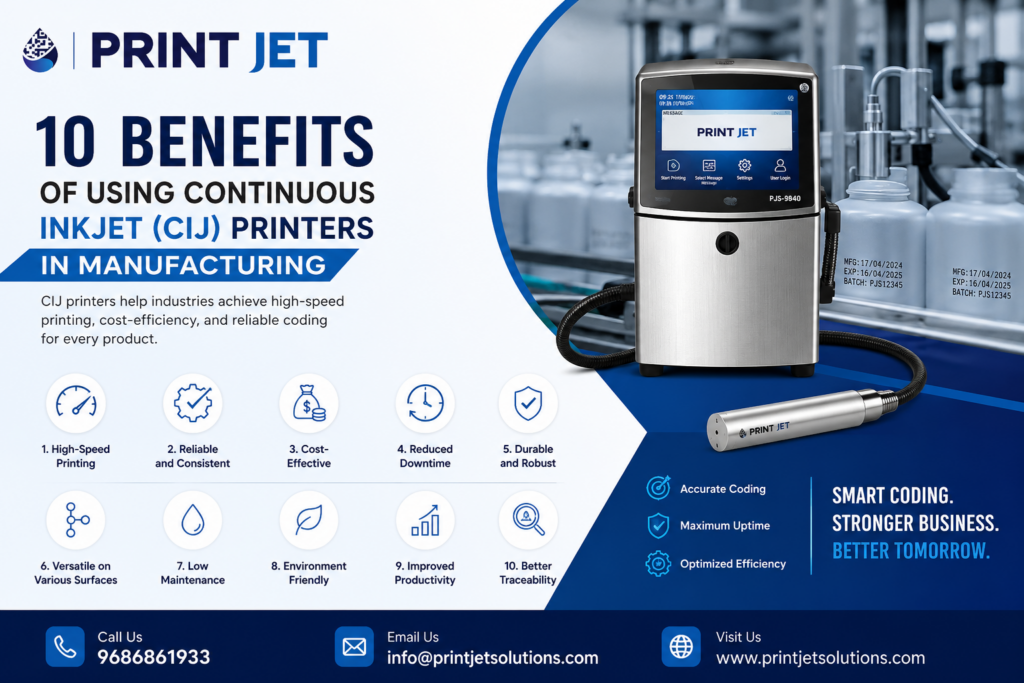
Continuous Inkjet technology operates by generating thousands of tiny ink droplets every second. These droplets are electrically charged and accurately directed onto products to create batch numbers, expiry dates, manufacturing dates, QR codes, barcodes, logos, serial numbers, and variable data. Any unused droplets are recycled back into the system, ensuring efficient ink usage and continuous operation.
One of the greatest advantages of CIJ technology is its ability to print without physical contact. Since the printhead never touches the product, manufacturers can code products of different shapes, sizes, and materials without slowing production. CIJ printers are compatible with plastic, PET bottles, glass, metal cans, aluminum, paper, cardboard, flexible films, cables, rubber, wood, ceramics, and electronic components. This versatility makes them indispensable across diverse industries.
Why CIJ Technology Dominates High-Speed Production
High-speed production environments demand coding systems that can keep pace without compromising print quality. Continuous Inkjet printers excel because they maintain consistent coding accuracy even on fast-moving conveyor lines. Industry reports indicate that CIJ systems account for a majority of installed industrial coding printers thanks to their exceptional speed, reliability, and ability to operate continuously with minimal interruptions. (Industry Research)
Top 10 Benefits of Continuous Inkjet Printers
1. High-Speed Printing Performance
The biggest reason manufacturers choose Continuous Inkjet Printers is speed. Production lines often operate around the clock, requiring coding systems that never become bottlenecks. CIJ printers can print thousands of characters every second while maintaining excellent readability.
Whether you’re printing on beverage bottles moving at high speed or pharmaceutical blister packs requiring precise serialization, CIJ technology ensures every product receives a clear code. This eliminates production slowdowns while supporting maximum throughput.
2. Excellent Print Quality on Multiple Surfaces
Few industrial printing technologies match the versatility of CIJ printers. They can print consistently on porous and non-porous materials alike. Whether the surface is smooth, glossy, rough, curved, or irregular, the printer delivers crisp, permanent codes.
Manufacturers no longer need separate printers for different packaging materials. A single CIJ printer can handle multiple product lines, reducing equipment investment while increasing production flexibility.
3. Non-Contact Printing Technology
Because CIJ printers never touch the product during printing, they are perfect for delicate packaging and fragile products. Glass bottles, plastic films, aluminum cans, medical packaging, and electronic components remain undamaged while receiving accurate identification codes.
This non-contact capability also reduces mechanical wear, allowing production lines to operate more efficiently with fewer maintenance interruptions.
4. Reduced Production Downtime
Downtime costs manufacturers thousands of dollars every hour. Modern CIJ printers include automated cleaning systems, self-diagnostics, quick-start functions, and preventive maintenance features that significantly reduce unexpected stoppages.
Many industrial CIJ printers now offer service intervals extending thousands of operating hours, enabling manufacturers to maximize uptime while lowering maintenance costs. (Markem-Imaje)
5. Superior Traceability and Regulatory Compliance
Today’s manufacturing regulations require complete product traceability from production to the end customer. Industries including pharmaceuticals, food processing, beverages, cosmetics, automotive, and electronics rely on accurate coding for compliance.
CIJ printers produce highly readable batch numbers, expiry dates, manufacturing dates, lot codes, QR Codes, 2D DataMatrix Codes, and barcodes, helping manufacturers meet international regulatory requirements while improving recall management.
6. Low Cost Per Print
One of the strongest financial advantages of Continuous Inkjet technology is its remarkably low operating cost. Although the initial investment may seem significant, the overall Total Cost of Ownership (TCO) remains highly competitive due to efficient ink usage, reduced downtime, and long equipment lifespan.
Businesses printing millions of products annually often recover their investment quickly through improved production efficiency and lower maintenance expenses.
7. Seamless Integration with Automation
Modern manufacturing increasingly depends on automation. CIJ printers integrate easily with conveyors, packaging machines, ERP systems, MES software, PLCs, scanners, vision inspection systems, and industrial automation platforms.
This integration enables automated coding verification, real-time monitoring, production data collection, and smart factory implementation, making CIJ printers an essential component of Industry 4.0 manufacturing.
8. Long-Term Reliability
Industrial environments demand robust equipment capable of operating continuously under harsh conditions. CIJ printers are designed for dust, vibration, humidity, and temperature variations commonly found in factories.
Manufacturers benefit from durable printheads, automated maintenance routines, and stable ink circulation systems that ensure years of reliable operation with minimal operator intervention.
9. Wide Ink Compatibility
Not every manufacturing application requires the same ink. Continuous Inkjet printers support an extensive range of specialty inks designed for different industries.
Available options include:
- Fast-drying inks
- Food-grade inks
- Pigmented inks
- UV-readable inks
- High-contrast inks
- Solvent-resistant inks
- Heat-resistant inks
- Chemical-resistant inks
This flexibility enables manufacturers to print permanent codes suitable for virtually every production environment.
10. Future-Ready Smart Manufacturing Solution
Manufacturing continues moving toward digital transformation, predictive maintenance, AI-driven quality control, and connected production systems. Continuous Inkjet printers have evolved alongside these technologies.
Today’s CIJ systems feature remote monitoring, cloud connectivity, automated diagnostics, touchscreen interfaces, production analytics, and predictive maintenance capabilities. These innovations position manufacturers for long-term operational excellence while supporting sustainability initiatives and operational efficiency.
Industries That Benefit from CIJ Printers
Continuous Inkjet technology serves virtually every manufacturing sector, including:
- Food Processing
- Beverage Manufacturing
- Pharmaceutical Manufacturing
- Cosmetics
- Personal Care
- Automotive Components
- Electrical & Electronics
- Wire & Cable
- Chemical Industry
- Building Materials
- Packaging Industry
- FMCG Manufacturing
Each of these industries relies on permanent product identification, making CIJ printers a critical part of modern production.
CIJ vs Other Industrial Coding Technologies
| Feature | CIJ Printer | TIJ Printer | TTO Printer | Laser Coder |
| High-Speed Production | Excellent | Good | Good | Excellent |
| Non-Contact Printing | Yes | Yes | No | Yes |
| Flexible Packaging | Excellent | Good | Excellent | Good |
| Curved Surfaces | Excellent | Limited | No | Excellent |
| Maintenance | Low | Low | Medium | Very Low |
| Ink Required | Yes | Yes | Ribbon | No |
| Best For | All-purpose manufacturing | Cartons | Flexible films | Permanent marking |
How to Choose the Right CIJ Printer
Selecting the ideal Industrial Continuous Inkjet Printer depends on several operational factors:
- Production speed
- Packaging material
- Print size requirements
- Environmental conditions
- Ink compatibility
- Maintenance expectations
- Integration with existing production lines
- Budget and long-term operating costs
Choosing a trusted supplier with reliable after-sales service, technical support, and readily available consumables is equally important for maximizing productivity.
Conclusion
Continuous Inkjet printers remain one of the most reliable and cost-effective coding solutions available for modern manufacturing. Their unmatched speed, exceptional substrate compatibility, low operating costs, and seamless integration with automated production systems make them indispensable across industries. As traceability regulations become stricter and smart factories continue to evolve, investing in Continuous Inkjet Printing Technology provides manufacturers with greater efficiency, improved compliance, and long-term operational success.
Frequently Asked Questions
1. What is a Continuous Inkjet (CIJ) printer?
A CIJ printer is an industrial coding system that continuously sprays microscopic ink droplets to print variable information such as batch numbers, expiry dates, QR codes, and barcodes on products and packaging.
2. Which industries use CIJ printers?
Food, beverage, pharmaceutical, automotive, cosmetics, electronics, packaging, cable, chemical, and FMCG industries widely use CIJ printers.
3. Can CIJ printers print on plastic and metal?
Yes. CIJ printers can print on plastic, PET, glass, metal, aluminum, paper, cardboard, rubber, cables, and many other materials.
4. Are CIJ printers suitable for high-speed production lines?
Absolutely. They are specifically designed for continuous, high-speed manufacturing environments and can maintain print quality even on fast-moving production lines. (Business Research Insights)
5. Why are CIJ printers preferred over other coding technologies?
CIJ printers offer high-speed performance, non-contact printing, versatility across different substrates, excellent reliability, and lower total operating costs, making them ideal for most manufacturing applications.