



 Article Outline
- What Is a TIJ Printer?
- How Thermal Inkjet Printing Works
- Why TIJ Printers Are Used in Modern Manufacturing
- Key Features of TIJ Printers
- High-Resolution Printing
- Variable Data and Barcode Printing
- What Can TIJ Printers Print?
- Industries That Use TIJ Printing
- TIJ Printers for Packaging Applications
- Primary and Secondary Packaging
- Benefits of Using a TIJ Printer
- TIJ vs CIJ: What Is the Difference?
- How to Choose the Right TIJ Printer
- Factors to Consider Before Buying
- TIJ Printer Maintenance and Best Practices
- Why High-Resolution Coding Matters
- TIJ Printers and Product Traceability
- Choosing a Coding and Marking Partner
- TIJ Printing in the Future of Manufacturing
- Why Choose PrintJet Solutions for TIJ Printing?
- Conclusion
- Frequently Asked Questions About TIJ Printers
Introduction
Modern manufacturing is all about speed, accuracy and traceability. Every product leaving a production line may need important information such as a batch number, manufacturing date, expiry date, MRP, serial number, barcode or QR code. Printing that information clearly is not simply a finishing step—it is an important part of product identification, quality control and supply-chain management. This is where TIJ printers, or Thermal Inkjet printers, have become an important industrial coding and marking solution for manufacturers looking for sharp, reliable and high-resolution codes.
Unlike traditional printing methods that may require labels or pre-printed packaging, thermal inkjet printing can place variable information directly onto suitable products and packaging as part of the production process. Modern TIJ systems are designed for applications where high-resolution printing, compact integration and straightforward operation are important. Industry manufacturers use TIJ technology for text, graphics, barcodes and 2D codes across packaging and product-identification applications. (Domino Printing)
For businesses evaluating an industrial printer, the real question is not simply, “What printer should I buy?” It is, “What type of coding technology fits my product, substrate, production speed and information requirements?” A good TIJ printer can be an excellent choice when crisp, machine-readable coding is a priority. In this guide, we will look at how TIJ technology works, its applications, benefits, maintenance requirements and the factors manufacturers should consider before selecting a coding and marking machine.
What Is a TIJ Printer?
A TIJ printer is a Thermal Inkjet printer that uses controlled heating to eject tiny droplets of ink onto a surface without physically contacting the product. The technology is designed for accurate placement of ink droplets, making it possible to produce clean text, graphics and machine-readable codes. Depending on the printer and ink configuration, TIJ systems can be used on a range of porous and non-porous materials. Modern industrial TIJ platforms are available for applications involving packaging, consumer products, pharmaceutical products and industrial components. (Domino Printing)
The technology is particularly attractive when print quality matters. A production line may be moving hundreds or thousands of products, yet every printed code still needs to be readable. A blurred batch number or poorly printed QR code can create unnecessary waste, rework or traceability problems. This is why high-resolution industrial printing has become increasingly important for manufacturers handling detailed product information.
How Thermal Inkjet Printing Works
The basic principle behind thermal inkjet printing is relatively straightforward. The printer contains microscopic heating elements within the printhead. When the system receives a printing command, the heating element rapidly heats a tiny quantity of ink, creating a bubble that forces an ink droplet through a nozzle onto the substrate.
The process happens extremely quickly and is precisely controlled to create characters, graphics and codes. Because the printhead does not need to touch the surface being printed, TIJ is considered a non-contact printing technology. This makes it useful for many production environments where direct contact with the product could be undesirable. (United States)
The exact performance of a TIJ system depends on the printer model, ink, substrate, print resolution, line speed and application setup. For example, some modern TIJ systems support high-resolution coding and can produce 1D and 2D barcodes, including QR codes and DataMatrix codes. (Domino Printing)
Why TIJ Printers Are Used in Modern Manufacturing
Manufacturing environments are becoming more data-driven. Products move through increasingly automated production lines, while manufacturers need to manage more SKUs, variable information and traceability requirements. A coding and marking machine therefore needs to do more than simply print a date.
A modern TIJ printer can be used to print variable information such as batch codes, manufacturing dates, expiry dates, serial numbers, product names, logos and machine-readable codes. Depending on the configuration, TIJ systems can also integrate with production equipment and data systems, helping manufacturers manage changing product information more efficiently. (Domino Printing)
Another important advantage is print clarity. When a manufacturer needs to print a small DataMatrix code, detailed barcode or multiple lines of text, resolution becomes critical. Industry suppliers offer TIJ systems specifically for applications where high-quality printing and ease of operation are important. (United States)
Key Features of TIJ Printers
A modern industrial TIJ printer can combine several features that make it suitable for automated manufacturing. While specifications differ between models, manufacturers commonly look for high-resolution output, flexible message creation, barcode support, compact integration and easy operation.
High-Resolution Printing
One of the biggest reasons businesses consider TIJ printers is their ability to produce sharp and detailed codes. High-resolution printing is especially valuable when the available printing area is small or when the application requires detailed machine-readable information.
For example, TIJ technology can be used for barcodes, QR codes, DataMatrix codes, logos, alphanumeric information and variable data. Some commercial TIJ systems advertise resolutions reaching up to 600 dpi, although actual resolution and print performance depend on the particular printer and application. (United States)
Clear printing also helps with automated code verification. If a production line uses a vision system to inspect printed information, consistent code quality becomes an important part of the overall process.
Variable Data and Barcode Printing
Manufacturers rarely print exactly the same information on every product. Batch numbers change, expiry dates change, serial numbers change and product variants may require different codes. A TIJ coding machine can be configured to handle variable information so that the correct message can be printed at the correct point in the production process.
Modern TIJ systems can support 1D barcodes, QR codes and DataMatrix codes, along with standard text and graphics. (Domino Printing) This makes them useful for applications where product identification and traceability are important.
What Can TIJ Printers Print?
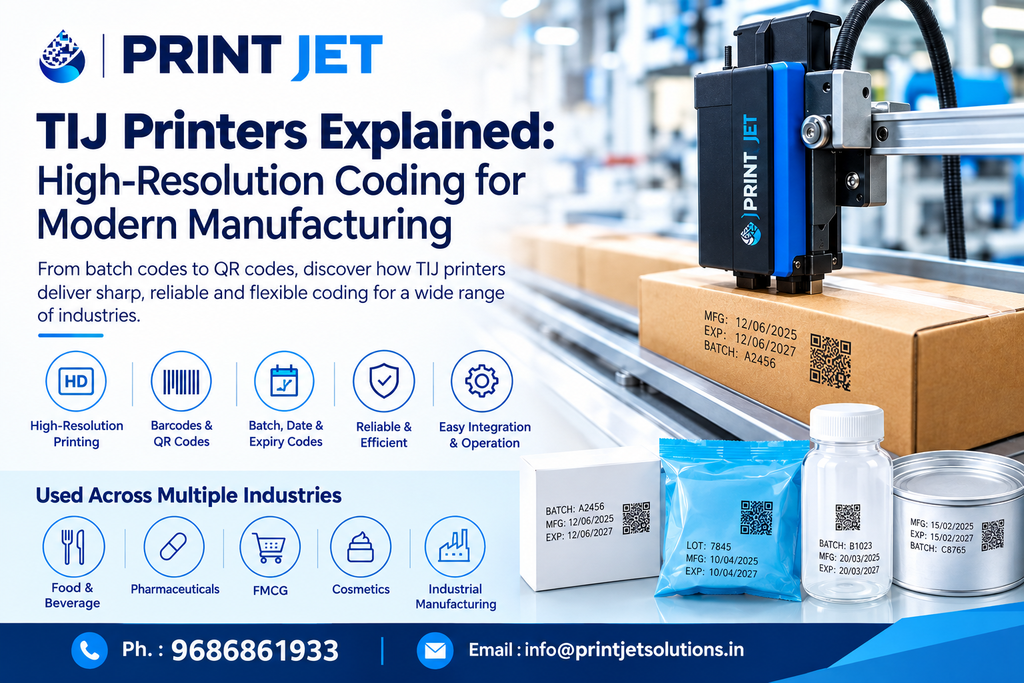
The flexibility of TIJ technology is one reason it is used across different manufacturing applications. The exact capabilities depend on the printer, ink and substrate, but typical applications can include:
- Batch numbers
- Manufacturing dates
- Expiry dates
- MRP and product information
- Serial numbers
- Barcodes
- QR codes
- DataMatrix codes
- Logos and graphics
- Product identification information
The ability to combine different types of information in one message is particularly useful for manufacturers with multiple SKUs. Instead of relying on a fixed pre-printed message, businesses can generate variable coding based on production data.
For example, a pharmaceutical package may require a batch number, expiry date and serialised code, while a food package might need a manufacturing date, expiry date and batch code. A logistics carton may require a barcode and shipping information. The industrial coding machine must therefore match the information requirements of the application rather than simply being selected based on printer price.
Industries That Use TIJ Printing
TIJ printers can be used across a variety of industries where clear variable coding is required. Their applications include food and beverage, pharmaceuticals, healthcare, cosmetics, FMCG and industrial manufacturing, among others. Industry manufacturers use TIJ technology for coding primary and secondary packaging as well as other product-identification applications. (Domino Printing)
In the pharmaceutical sector, high-resolution and machine-readable coding can support product identification and traceability. TIJ technology is used for codes such as DataMatrix and QR codes, along with alphanumeric information. (United States)
In food and FMCG manufacturing, businesses may need to print dates and batch information quickly on cartons, packaging materials and other suitable substrates. For industrial manufacturers, TIJ can be used for identification information, barcodes and other variable data where the selected ink and substrate are compatible.
The important point is that there is no single “best” printer for every industry. The correct coding and marking solution depends on the product, packaging material, production environment, line speed and required print information.
TIJ Printers for Packaging Applications
Packaging is one of the most important application areas for thermal inkjet printing. Packaging lines often require fast, accurate and variable coding without slowing production. TIJ systems can be integrated into production lines to print information while products or packages move through the manufacturing process.
Primary and Secondary Packaging
Primary packaging comes directly into contact with the product, while secondary packaging provides additional protection and presentation. Depending on the application and ink selected, TIJ technology can be used across different packaging substrates.
For example, industry suppliers describe TIJ applications involving paper, card, plastic and other materials, while specific ink technologies can be selected for different surface characteristics. (Domino Printing)
For manufacturers, substrate compatibility should always be evaluated before selecting a TIJ printer. A printer that performs exceptionally well on cartons may require a different ink configuration for plastic film or another non-porous material. A proper application test is therefore an important part of choosing the right industrial coding machine.
Benefits of Using a TIJ Printer
The main attraction of TIJ printing machines is the combination of print quality, flexibility and integration potential. Manufacturers want codes that look professional to customers but also remain readable by scanners and automated systems.
High-resolution output is one of the most important advantages. Detailed text, barcodes and 2D codes can be printed in a compact area, making TIJ suitable for applications where available print space is limited. (United States)
Another advantage is the cartridge-based approach used by many TIJ systems. Depending on the system, cartridge replacement can be relatively straightforward, helping simplify routine operator tasks. Videojet, for example, describes its TIJ technology as requiring simple cleaning of the cartridge print array and printhead. (United States)
TIJ printers can also be designed for integration into automated production lines. Modern systems may support communication with production equipment and digital manufacturing systems, depending on the model. (Domino Printing)
TIJ vs CIJ: What Is the Difference?
One of the most common questions manufacturers ask is whether they should choose TIJ or CIJ. Both are non-contact inkjet technologies, but they work differently and are suited to different application requirements.
| Feature | TIJ Printer | CIJ Printer |
| Full form | Thermal Inkjet | Continuous Inkjet |
| Printing method | Thermal ejection of ink droplets | Continuous stream of ink droplets |
| Print quality | High-resolution applications | Excellent for many industrial coding applications |
| Typical applications | Detailed codes, packaging, barcodes, QR codes | High-speed product and packaging coding |
| Maintenance approach | Often cartridge-based | Requires fluid and system management depending on model |
| Integration | Compact integration options | Widely used for production-line integration |
| Best selection factor | Resolution, code complexity and substrate | Speed, substrate, environment and continuous production needs |
There is no universal answer to whether TIJ or CIJ is better. The right choice depends on the application. CIJ can be advantageous for certain high-speed applications and a broad range of substrates, while TIJ is particularly attractive when high-resolution coding and detailed machine-readable information are priorities. (Domino Printing)
A professional coding and marking solutions provider can evaluate the substrate, production speed, required code, installation environment and operating conditions before recommending the technology.
How to Choose the Right TIJ Printer
Choosing a TIJ printer should start with the application rather than the machine specification sheet. Before investing in an industrial printer, manufacturers should identify exactly what needs to be printed, where it needs to be printed and how quickly the production line operates.
Factors to Consider Before Buying
Consider the following:
- Substrate: Is the surface paper, cardboard, plastic, film, metal or coated material?
- Print content: Do you need text, dates, barcodes, QR codes, DataMatrix codes or graphics?
- Print resolution: How detailed and compact does the code need to be?
- Production speed: What is the maximum line speed?
- Print height: How large does the message need to be?
- Ink requirements: Is the surface porous or non-porous?
- Integration: Does the printer need to communicate with conveyors, PLCs, databases or other equipment?
- Operating environment: Is the machine exposed to dust, moisture, heat or other conditions?
- Maintenance: How frequently will operators need to clean or service the system?
- Technical support: Is local installation, training and after-sales support available?
A printer may look impressive on paper, but the real test is how it performs on your actual product at your actual production speed. That is why print sampling and application evaluation are valuable before final selection.
TIJ Printer Maintenance and Best Practices
Even a sophisticated industrial printer needs proper care. Good maintenance helps protect print quality and reduce avoidable interruptions. Operators should follow the manufacturer’s recommended cleaning, cartridge handling and operating procedures rather than treating maintenance as an afterthought.
Because TIJ systems use precision printheads and small nozzles, contamination can affect print quality. Dust, dried ink or unsuitable handling can result in missing dots, inconsistent characters or reduced barcode quality. Regular inspection and appropriate cleaning procedures can help maintain reliable operation.
Operators should also use the correct ink and cartridge for the application. Ink selection is particularly important when printing on non-porous surfaces, films, foils or coated materials. Some industrial TIJ ink ranges are specifically designed for such substrates. (United States)
The goal is simple: keep the printer clean, use compatible consumables, follow operating instructions and monitor print quality regularly. Preventive attention is generally easier than troubleshooting a production problem after poor coding has already created rejected products.
Why High-Resolution Coding Matters
Imagine scanning a QR code at a warehouse and the scanner cannot read it. The problem may look small, but on a large production line it can become a serious operational issue. High-resolution coding helps manufacturers create sharp and consistent information that can be read by people and automated equipment.
Barcode quality is especially important when codes are used for traceability. Modern TIJ systems are available with support for machine-readable codes including DataMatrix and QR codes. (Domino Printing)
High-quality printing can also improve the appearance of packaging. A clean batch number or expiry date looks more professional than a faded, distorted or poorly positioned code. For consumer-facing products, that seemingly small detail can contribute to overall packaging quality.
This is why selecting a high-resolution industrial printer should not be based solely on maximum speed. Print clarity, substrate compatibility, code verification, integration and reliability all need to be considered together.
TIJ Printers and Product Traceability
Product traceability has become increasingly important across manufacturing and supply chains. Businesses need to know where products came from, when they were produced and, in many applications, how individual products can be identified.
TIJ printers can contribute to this process by printing variable identifiers such as serial numbers, barcodes, QR codes and DataMatrix codes. Depending on the printer and software configuration, these codes can be generated and managed as part of a broader production and traceability workflow. (Domino Printing)
For pharmaceutical and healthcare applications in particular, machine-readable identification can play an important role. Some industrial TIJ platforms are designed to support serialization and traceability requirements. (Domino Printing)
For manufacturers, the bigger picture matters. A coding machine should not be viewed as an isolated piece of equipment. When combined with conveyors, vision inspection, production data and automation systems, coding can become part of a connected manufacturing process.
Choosing a Coding and Marking Partner
Buying an industrial coding machine is only one part of implementing a successful printing solution. Installation, application testing, operator training, maintenance, consumables and technical support can all influence the long-term performance of the system.
This is where an experienced coding and marking solutions provider can add value. Instead of simply supplying a printer, the provider can help assess your substrate, production line, required code and integration requirements.
For a business evaluating TIJ printers in Bangalore or across India, local technical support can also be an important consideration. Faster access to installation, troubleshooting, maintenance and consumables can help reduce unnecessary production interruptions.
PrintJet Solutions focuses on coding and marking, printing, handling systems, vision systems and industrial automation, making TIJ technology a natural part of a broader production-line solution.
TIJ Printing in the Future of Manufacturing
Manufacturing is moving toward greater automation, connectivity and data visibility. Printing technology is following the same direction. Modern industrial TIJ platforms increasingly support connectivity, remote monitoring, automated data handling and integration with production systems. For example, current Domino TIJ systems include connectivity and Industry 4.0-related capabilities, depending on the model. (Domino Printing)
This means the future of industrial coding and marking is not simply about printing faster. It is about printing the right information, on the right product, at the right time—and making that information part of a connected manufacturing workflow.
Vision inspection can also complement coding systems by checking whether codes are present and readable. Recent industry solutions demonstrate how TIJ coding can be combined with vision systems for automated verification. (Domino Printing)
For manufacturers planning new production lines, this opens the door to smarter coding, marking, inspection and automation solutions that work together rather than operating as separate systems.
Why Choose PrintJet Solutions for TIJ Printing?
Choosing the right TIJ printer is easier when you have access to technical guidance before making a purchase. PrintJet Solutions provides coding and marking solutions for industrial applications and can help businesses evaluate their printing requirements based on product type, substrate, production line and coding needs.
Whether your requirement involves batch coding, date coding, barcode printing, QR code printing or high-resolution product identification, the right printer configuration can make a significant difference to production efficiency and print quality.
A TIJ system should ultimately fit into your complete manufacturing process—not force your production line to adapt around the printer. With the right combination of industrial printing, handling systems, vision systems and automation, manufacturers can build a more efficient and traceable production environment.
For businesses looking for TIJ printers in India, the next step should be application evaluation and print testing. This helps determine the appropriate printer, ink, printhead configuration and integration approach for the specific production requirement.
Conclusion
TIJ printers have become an important technology for manufacturers that need clean, detailed and high-resolution product coding. From batch numbers and expiry dates to barcodes, QR codes, DataMatrix codes and variable information, thermal inkjet technology can support a wide range of modern manufacturing applications. Current industrial TIJ systems are designed for high-quality coding and can integrate into production environments, with some platforms offering connectivity and advanced data-management capabilities. (Domino Printing)
The right coding and marking machine ultimately depends on your application. Production speed, substrate, print content, resolution, ink type, integration requirements and maintenance should all be evaluated before selecting a system. Rather than choosing a printer based on one specification, manufacturers should look at the complete printing process.
For businesses considering TIJ printing solutions, a professional application assessment can help identify the right technology and configuration. With the right system in place, high-resolution coding becomes more than simply putting information on a package—it becomes part of a reliable, efficient and traceable manufacturing operation.
Frequently Asked Questions About TIJ Printers
1. What is a TIJ printer?
A TIJ printer, or Thermal Inkjet printer, is a non-contact industrial printing system that uses controlled heat to eject tiny ink droplets onto a surface. It is commonly used for printing batch numbers, dates, barcodes, QR codes, DataMatrix codes, serial numbers and other variable information. (United States)
2. What are TIJ printers used for?
TIJ printers are used for product identification and packaging coding across industries such as food and beverage, pharmaceuticals, FMCG, healthcare, cosmetics and industrial manufacturing. Applications can include date coding, batch coding, barcode printing, QR code printing and traceability coding. (Domino Printing)
3. Are TIJ printers suitable for barcode and QR code printing?
Yes. Modern industrial TIJ systems can print 1D barcodes, QR codes and DataMatrix codes, along with text and graphics. Print quality, ink selection, substrate and code design all influence the final readability of the code. (Domino Printing)
4. What is the difference between TIJ and CIJ printers?
TIJ and CIJ are different inkjet technologies. TIJ is particularly suitable for applications requiring high-resolution coding and detailed machine-readable information, while CIJ is widely used for continuous, high-speed industrial coding across many substrates. The appropriate technology depends on the product, substrate, production speed and coding requirements. (United States)
5. How do I choose the right TIJ printer for my business?
Start by evaluating your substrate, production speed, print content, required resolution, print height, ink requirements, environmental conditions and production-line integration needs. A print sample or application assessment is recommended before purchasing an industrial TIJ printer, because the best configuration depends on the actual product and production environment.