



Article Outline
- Complete Guide to Industrial Coding and Marking Systems in Manufacturing
- Introduction to Industrial Coding and Marking
- What Is Industrial Coding and Marking?
- Why Every Manufacturing Industry Needs It
- How Industrial Coding and Marking Systems Work
- Variable Data Printing
- Integration with Production Lines
- Types of Industrial Coding and Marking Technologies
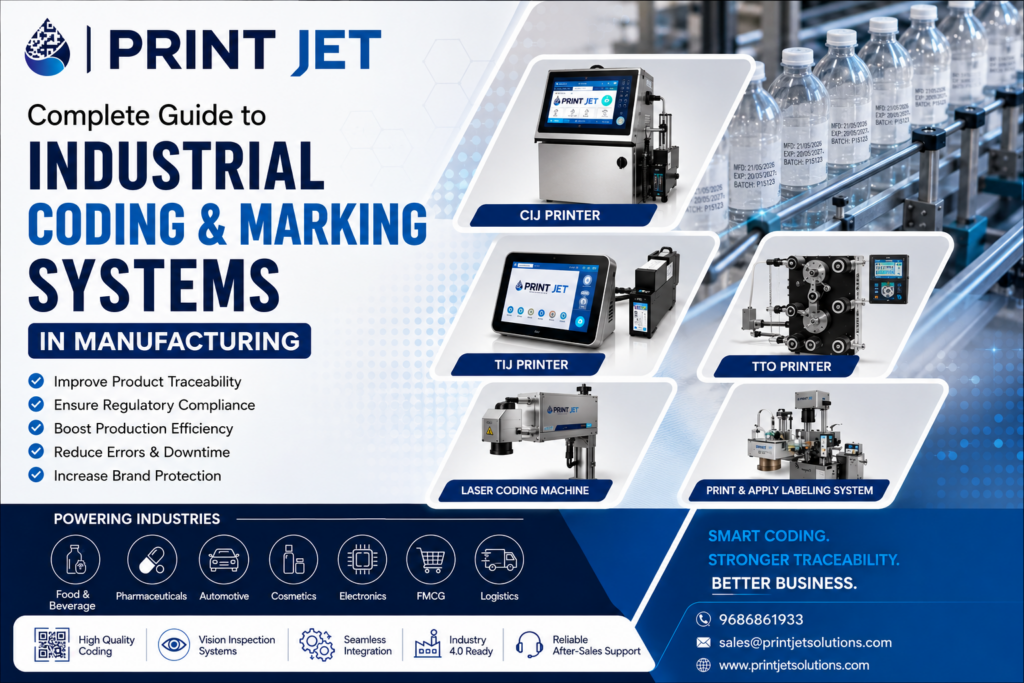
- Continuous Inkjet (CIJ) Printers
- Thermal Inkjet (TIJ) Printers
- Thermal Transfer Overprinting (TTO)
- Laser Coding Machines
- Print and Apply Labeling Systems
- Comparing Industrial Coding Technologies
- Industries That Depend on Coding and Marking
- Compliance, Traceability, and Global Standards
- GS1 Standards and Serialization
- Food, Pharma, and Export Regulations
- Choosing the Right Coding and Marking Solution
- Future Trends in Industrial Coding and Marking
- Conclusion
- Frequently Asked Questions
- Introduction to Industrial Coding and Marking
Complete Guide to Industrial Coding and Marking Systems in Manufacturing
Introduction to Industrial Coding and Marking
Modern manufacturing is no longer just about producing quality products—it is equally about ensuring every product is traceable, compliant, and easily identifiable throughout the supply chain. Whether you’re purchasing a bottle of medicine, a packaged food item, or an automotive component, you’ll notice printed information such as manufacturing dates, expiry dates, batch numbers, QR codes, serial numbers, barcodes, or logos. These markings are created using industrial coding and marking systems, which have become indispensable in today’s manufacturing landscape.
As global supply chains continue to expand and governments introduce stricter product traceability regulations, manufacturers are investing heavily in reliable coding technologies. According to recent industry reports, the global coding and marking systems market was valued at approximately USD 6.7 billion in 2025 and is projected to reach over USD 10 billion by 2032, driven by increased automation, serialization requirements, and Industry 4.0 adoption.
Industrial coding systems do much more than print dates on packaging. They help manufacturers improve inventory management, prevent counterfeiting, simplify recalls, enhance brand protection, and meet international regulatory standards. Whether operating in food processing, pharmaceuticals, electronics, cosmetics, automotive, or FMCG, choosing the right coding technology directly impacts productivity, operational costs, and customer trust.
In this comprehensive guide, you’ll learn everything about industrial coding and marking technologies, how they work, where they’re used, and how to select the right solution for your production line.
What Is Industrial Coding and Marking?
Industrial coding and marking refers to the process of permanently or semi-permanently printing information onto products, packaging, labels, cartons, cables, bottles, metals, plastics, and numerous other substrates. The information may include:
-
Manufacturing Date
-
Expiry Date
-
Batch Number
-
Lot Number
-
QR Codes
-
Data Matrix Codes
-
Serial Numbers
-
Barcodes
-
Logos
-
Variable Text
-
Product Identification Numbers
Unlike traditional printing, industrial coding occurs at extremely high production speeds while maintaining excellent print quality and durability. Modern coding machines can synchronize with conveyors, filling machines, packaging equipment, ERP software, MES systems, and vision inspection systems to ensure accurate, automated printing without slowing production.
Today’s manufacturers increasingly use 2D barcodes, GS1 DataMatrix codes, and serialized product identifiers to improve traceability and support digital supply chains. GS1 standards enable products, locations, and logistics units to be uniquely identified, captured, and shared across supply chains, making end-to-end traceability possible.
Why Every Manufacturing Industry Needs Industrial Coding and Marking
Industrial coding and marking have evolved from being simple product identification tools into critical components of modern manufacturing. In today’s highly competitive environment, manufacturers are expected to deliver products that are safe, authentic, compliant, and fully traceable. Governments around the world have introduced stricter regulations for product labeling, while consumers increasingly expect transparency about the products they purchase. Coding and marking systems help manufacturers meet these expectations without disrupting production efficiency.
One of the biggest advantages of industrial coding is product traceability. Every product leaving a manufacturing facility can carry unique information such as batch numbers, serial numbers, manufacturing dates, expiry dates, and QR codes. If a defect is discovered later, manufacturers can quickly identify affected batches instead of recalling every product in circulation. This significantly reduces financial losses and protects brand reputation.
Industrial coding also plays a major role in preventing counterfeiting. Unique serial numbers, variable QR codes, and Data Matrix codes allow products to be authenticated throughout the supply chain. Industries such as pharmaceuticals, cosmetics, electronics, and luxury goods rely heavily on advanced coding technologies to safeguard their brands against counterfeit products.
From an operational perspective, automated coding systems reduce manual intervention and eliminate common human errors. Since the printers integrate directly with production lines, coding information is generated automatically from production databases or enterprise software. This minimizes incorrect date printing, missing batch numbers, and labeling mistakes while increasing production speed and consistency.
Another important advantage is compliance with international regulations. Food manufacturers must display expiry dates and ingredient-related information, pharmaceutical companies need serialization and track-and-trace capabilities, while export businesses often require multilingual labels and internationally recognized barcodes. Industrial coding systems simplify compliance with these requirements and reduce the risk of costly penalties.
How Industrial Coding and Marking Systems Work
Understanding how Industrial Coding and Marking Systems operate helps manufacturers choose the right technology for their production environment. Modern coding and marking systems are designed to print variable information automatically while products move along high-speed production lines. Unlike traditional printing methods that repeatedly print identical information, industrial coding and marking requires every product—or every batch—to receive unique data such as manufacturing dates, expiry dates, serial numbers, GS1 barcodes, QR codes, and Data Matrix codes.
The coding process begins when a product reaches the printing station on the conveyor. A photoelectric sensor detects the product’s position and immediately sends a signal to the industrial coding machine. Based on predefined production data stored in the printer or received from an ERP or Manufacturing Execution System (MES), the printer generates the required information in real time using Variable Data Printing technology. This automated workflow eliminates manual data entry, significantly reducing the risk of incorrect dates, batch numbers, or product identifiers.
Modern coding machines for manufacturing seamlessly integrate with conveyors, packaging machines, robotic systems, PLCs, and industrial automation platforms. Operators can create coding templates for different products, and the printer automatically switches between jobs based on production schedules. Many manufacturers also integrate Vision Inspection Systems immediately after the printing station. These intelligent inspection cameras verify barcode readability, print clarity, code placement, and character accuracy. If a code is missing, unreadable, or incorrectly positioned, the system triggers an automatic rejection mechanism, ensuring only compliant products continue through the production process.
Cloud connectivity has also transformed manufacturing coding solutions. Today’s industrial printing solutions allow production managers to monitor printer performance remotely, receive predictive maintenance alerts, check ink or ribbon levels, analyze production statistics, and troubleshoot issues without physically visiting the production line. These smart capabilities support Industry 4.0, enabling factories to achieve greater efficiency, reduced downtime, and improved operational visibility.
Variable Data Printing (VDP): The Core of Modern Product Coding and Marking
One of the defining features of today’s Industrial Coding and Marking Systems is Variable Data Printing (VDP). Instead of printing identical information repeatedly, Variable Data Printing allows every individual product to receive unique information generated dynamically during production. This capability is essential for product traceability, serialization, quality control, and regulatory compliance.
Common examples of variable data include:
- Manufacturing Date
- Expiry Date
- Batch Number
- Lot Number
- Unique Serial Numbers
- QR Code Printing Machine generated codes
- Barcode Printing System outputs
- GS1 DataMatrix Codes
- Product Identification Numbers
- Promotional Codes
- Shift Information
- Operator Identification
For example, pharmaceutical manufacturers use serialized codes to comply with global track and trace systems, while food manufacturers print manufacturing and expiry dates to support rapid product recalls when necessary. Electronics companies assign unique serial numbers to every component, enabling complete lifecycle tracking and warranty management.
Modern industrial coding machines retrieve this information directly from ERP databases, MES software, or centralized production servers. This automation minimizes operator intervention while ensuring every printed code is accurate and consistent across multiple production lines.
Integration with Production Lines
Successful industrial coding depends not only on the printer itself but also on how effectively it integrates with the overall production process. Modern coding systems are engineered to work seamlessly alongside filling machines, packaging equipment, labeling systems, conveyors, robotic arms, inspection cameras, and factory automation software.
When properly integrated, coding machines automatically receive production jobs based on the current manufacturing schedule. Operators no longer need to manually enter dates or batch information, reducing the likelihood of human error. The printer adjusts coding parameters based on product size, conveyor speed, and substrate type, ensuring consistent print quality across high-speed production environments.
Industrial communication protocols such as Ethernet/IP, PROFINET, Modbus TCP, and OPC UA enable printers to exchange information with PLCs and factory management systems. This connectivity allows manufacturers to monitor printer status, ink levels, maintenance schedules, and production statistics from a centralized dashboard.
Integration with Vision Inspection Systems further enhances quality control. High-speed cameras inspect every printed code for clarity, position, and readability. If an unreadable barcode or incorrect date is detected, the system triggers an automatic rejection mechanism, ensuring that only correctly coded products reach customers.
As factories continue adopting Industry 4.0 technologies, integrated coding and marking systems are becoming smarter, more connected, and increasingly capable of supporting fully automated production environments.
Types of Industrial Coding and Marking Technologies
Selecting the right coding technology is one of the most important decisions for any manufacturer. Different production environments require different printing methods depending on factors such as production speed, substrate material, print durability, operating costs, and maintenance requirements.
The most widely used industrial coding technologies include:
- Continuous Inkjet (CIJ) Printers
- Thermal Inkjet (TIJ) Printers
- Thermal Transfer Overprinting (TTO) Systems
- Laser Coding Machines
- Print and Apply Labeling Systems
Each technology has its own strengths and is designed for specific applications. Understanding these differences helps manufacturers choose the most cost-effective and efficient solution for their production line.
Continuous Inkjet (CIJ) Printers
Among all Industrial Coding and Marking Systems, the Continuous Inkjet Printer (CIJ) remains one of the most widely adopted technologies due to its exceptional versatility and ability to operate on high-speed production lines. A CIJ printer continuously generates microscopic ink droplets, electrically charges selected droplets, and directs them onto the product surface with remarkable precision. Unused droplets are collected and recycled back into the ink circulation system, making the technology both efficient and reliable.
One of the greatest strengths of a Continuous Inkjet (CIJ) Printer is its ability to print without making physical contact with the product. This non-contact printing method allows manufacturers to code curved bottles, flexible packaging, irregularly shaped containers, metal parts, glass jars, plastic packaging, cables, and moving cartons without affecting production speed.
Because of their flexibility, CIJ printers are extensively used in industries such as:
- Food & Beverage
- Pharmaceuticals
- FMCG
- Cosmetics
- Automotive
- Electronics
- Chemical Manufacturing
- Building Materials
Modern CIJ printers can produce:
- Manufacturing Dates
- Expiry Dates
- Batch Numbers
- Lot Numbers
- Logos
- QR Codes
- Barcodes
- Data Matrix Codes
- Product Descriptions
- Serial Numbers
These printers can maintain excellent print quality even on production lines exceeding hundreds of products per minute, making them ideal for demanding manufacturing environments.
Advantages of Continuous Inkjet (CIJ) Printers
The popularity of CIJ printers is driven by several operational advantages:
- High-speed printing for continuous production
- Excellent performance on porous and non-porous materials
- Non-contact printing reduces product damage
- Suitable for curved, uneven, and irregular surfaces
- Wide range of specialty inks, including food-grade, UV-readable, pigmented, and solvent-resistant formulations
- Excellent compatibility with industrial automation systems
- Easy integration with Vision Inspection Systems
- Reliable batch coding machine functionality for high-volume manufacturing
Manufacturers seeking dependable coding and marking solutions for manufacturing often choose Continuous Inkjet Printers because they provide an excellent balance of speed, flexibility, durability, and overall cost-effectiveness.
Typical Applications of CIJ Printers
A Continuous Inkjet Printer is commonly used for printing on:
- PET bottles
- Glass bottles
- Aluminum cans
- Plastic containers
- Corrugated cartons
- Metal components
- Electrical cables
- Pipes
- Pharmaceutical blister packs
- Beverage packaging
- Cosmetic containers
This broad substrate compatibility makes the CIJ printer one of the most versatile industrial coding machines available today.
Thermal Inkjet (TIJ) Printers
The Thermal Inkjet Printer (TIJ) has become an increasingly popular choice for manufacturers requiring exceptional print quality with minimal maintenance. Unlike Continuous Inkjet Printers, a TIJ printer uses thermal energy to eject microscopic ink droplets through precision nozzles. A tiny heating element rapidly vaporizes a small amount of ink, creating pressure that forces an accurately controlled droplet onto the product surface. This process occurs thousands of times every second, producing extremely sharp text, graphics, and machine-readable codes.
One of the biggest advantages of Thermal Inkjet (TIJ) Printers is their outstanding print resolution, which can reach up to 600 dpi. This high resolution makes TIJ printers particularly suitable for printing:
- High-density QR Codes
- GS1 DataMatrix Codes
- Logos
- Product Graphics
- High-resolution Barcodes
- Batch Numbers
- Manufacturing Dates
- Expiry Dates
- Promotional Codes
Industries such as pharmaceuticals, cosmetics, medical devices, electronics, food packaging, and consumer goods rely on TIJ printers because barcode readability and print accuracy are essential for regulatory compliance and automated warehouse scanning.
Benefits of Thermal Inkjet (TIJ) Printers
Compared with many other coding and marking systems, TIJ printers offer several operational advantages:
- Outstanding print quality up to 600 dpi
- Low maintenance due to disposable cartridges
- Integrated printhead replacement with every cartridge
- Minimal downtime
- Compact design for easy installation
- Clean operation without ink circulation systems
- Excellent product coding and marking accuracy
- Lower total maintenance costs
These advantages make Thermal Inkjet Printers an attractive option for manufacturers looking to improve coding quality while reducing maintenance requirements.
Applications of TIJ Printers
A TIJ printer is ideally suited for printing on:
- Corrugated cartons
- Folding cartons
- Labels
- Paper packaging
- Pharmaceutical cartons
- Wooden packaging
- Coated packaging materials
- Flexible packaging (with compatible inks)
- Plastic containers (using solvent-based cartridges)
Because of their compact footprint and high-resolution capabilities, Thermal Inkjet Printers are frequently installed in secondary packaging lines, warehouse operations, and high-quality barcode printing systems where print clarity is a top priority.
A Continuous Inkjet (CIJ) Printer is the preferred solution for manufacturers running high-speed production lines with a wide variety of substrates. In contrast, a Thermal Inkjet (TIJ) Printer is ideal when crisp, high-resolution printing and minimal maintenance are the top priorities.
Thermal Transfer Overprinter (TTO): The Preferred Solution for Flexible Packaging
Among modern Industrial Coding and Marking Systems, the Thermal Transfer Overprinter (TTO) has become the industry standard for printing on flexible packaging materials. Unlike Continuous Inkjet (CIJ) Printers or Thermal Inkjet (TIJ) Printers, a TTO printer uses a thermal printhead to transfer ink from a ribbon directly onto packaging films through controlled heat and pressure. The result is a high-resolution, durable print that resists smudging, scratching, and chemical exposure.
As flexible packaging continues to dominate industries such as food processing, pharmaceuticals, personal care, and consumer goods, manufacturers increasingly rely on Thermal Transfer Overprinters (TTO) to achieve superior print quality without compromising production speed. Products such as snack foods, coffee pouches, frozen foods, spices, confectionery, pet food, medical devices, and cosmetic sachets require clear and permanent coding that remains legible throughout transportation, storage, and retail display.
Modern TTO printers support Variable Data Printing, allowing manufacturers to print dynamic information such as manufacturing dates, expiry dates, batch numbers, lot numbers, serial numbers, QR codes, GS1 DataMatrix codes, promotional messages, and multilingual product information. Because the printing process is digitally controlled, every package can receive unique identification without slowing down the packaging line.
One of the biggest advantages of Thermal Transfer Overprinters is their seamless integration with Vertical Form Fill Seal (VFFS) and Horizontal Form Fill Seal (HFFS) packaging machines. Whether the packaging line operates in continuous motion or intermittent motion, a TTO printer delivers consistent print quality while maximizing production efficiency. Many modern coding and marking systems also feature ribbon-saving technology that minimizes ribbon waste, reducing operational costs and improving sustainability.
Benefits of Thermal Transfer Overprinters (TTO)
Manufacturers choose TTO printers because they offer several operational advantages:
- Exceptional print resolution for text, graphics, and barcodes
- Excellent durability on flexible packaging films
- Smudge-resistant and abrasion-resistant printing
- Supports Barcode Printing Systems and QR Code Printing Machines
- Minimal maintenance requirements
- Reduced ribbon consumption through intelligent ribbon-saving technology
- High-speed operation suitable for automated packaging lines
- Easy integration with industrial automation systems
- Reliable product coding and marking for regulated industries
Typical Applications of TTO Printers
A Thermal Transfer Overprinter is widely used for printing on:
- Flexible food packaging
- Snack food wrappers
- Coffee and tea pouches
- Frozen food bags
- Medical packaging
- Cosmetic sachets
- Pharmaceutical packaging films
- Laminated packaging materials
- Stand-up pouches
- Vacuum packaging
For manufacturers using flexible films, TTO printers provide one of the most cost-effective manufacturing coding solutions, combining premium print quality with excellent production efficiency.
Laser Coding Machines: Permanent and Maintenance-Free Product Marking
As manufacturers pursue greater efficiency and sustainability, Laser Coding Machines have become one of the fastest-growing segments within the Industrial Coding and Marking Systems market. Unlike ink-based technologies, a Laser Coding Machine creates permanent marks by directing a highly focused laser beam onto the product surface. Depending on the material, the laser either engraves, discolors, foams, or vaporizes a thin surface layer to produce crisp, permanent markings.
Because Laser Coding Machines do not require inks, solvents, or ribbons, they significantly reduce operating costs and maintenance requirements. Although the initial investment is generally higher than ink-based industrial coding machines, the long-term savings often make laser technology the most economical solution for high-volume manufacturing operations.
Modern Laser Coding Machines are capable of printing:
- Manufacturing Dates
- Expiry Dates
- Batch Numbers
- Serial Numbers
- Logos
- QR Codes
- GS1 DataMatrix Codes
- High-resolution Barcodes
- Product Identification Codes
- Regulatory Symbols
These permanent markings cannot be easily erased, making Laser Coding Machines ideal for product traceability, anti-counterfeiting initiatives, and lifetime product identification.
CO₂ Laser Coding Machines
A CO₂ Laser Coding Machine uses carbon dioxide gas to generate a laser beam that interacts effectively with organic and non-metallic materials. It is one of the most commonly used laser technologies in packaging and consumer goods manufacturing.
Best Applications
- PET bottles
- Paper cartons
- Corrugated boxes
- Glass bottles
- Wooden packaging
- Labels
- Flexible packaging
- Food containers
Advantages
- Permanent high-quality marking
- Excellent for non-metallic materials
- No consumables
- Low operating cost
- High-speed production capability
- Environmentally friendly operation
Many beverage manufacturers prefer CO₂ Laser Coding Machines because they produce clean, permanent date codes on PET bottles without requiring ink replenishment.
Fiber Laser Marking Machines
A Fiber Laser Marking Machine is specifically engineered for marking metals and engineering plastics. It generates a concentrated laser beam using fiber optic technology, producing extremely fine and durable markings that withstand heat, abrasion, chemicals, and harsh industrial environments.
Industries such as automotive, aerospace, electronics, engineering, and medical device manufacturing rely heavily on Fiber Laser Marking Machines for permanent component identification.
Common Applications
- Stainless steel components
- Aluminum parts
- Automotive engine components
- Bearings
- Surgical instruments
- Electronic housings
- Industrial tools
- Electrical connectors
Benefits
- Extremely durable markings
- High-speed engraving
- Excellent precision
- Maintenance-free operation
- Long laser lifespan
- Ideal for serialization and track and trace systems
UV Laser Marking Machines
A UV Laser Marking Machine operates at a shorter wavelength than CO₂ and fiber lasers, allowing it to mark delicate materials without generating excessive heat. This “cold marking” technology minimizes material damage while delivering exceptional print quality.
Typical Applications
- Medical devices
- Pharmaceutical packaging
- Electronic components
- Cosmetic containers
- Plastic bottles
- Flexible films
- Sensitive polymers
Key Benefits
- High-resolution permanent marking
- Minimal heat damage
- Excellent for delicate materials
- Outstanding barcode readability
- Supports Barcode Printing Systems
- Ideal for QR Code Printing Machines
- Superior cosmetic appearance
As manufacturers increasingly adopt premium packaging, UV Laser Marking Machines continue gaining popularity for applications where product aesthetics are as important as durability.
Print and Apply Labeling Systems
Not every manufacturing application is suitable for direct product coding. Many logistics, warehousing, pharmaceutical, and export operations require larger labels containing shipping information, customer details, compliance data, and warehouse tracking codes. In these situations, Print and Apply Labeling Systems become an essential component of modern Industrial Coding and Marking Systems.
A Print and Apply Labeling System automatically prints labels using thermal printing technology and immediately applies them to products, cartons, pallets, shrink-wrapped loads, or shipping containers. These systems eliminate manual labeling, improve accuracy, and significantly increase production efficiency.
Modern Print and Apply Labeling Systems support:
- GS1 Barcodes
- Shipping Labels
- SSCC Labels
- Product Identification Labels
- Logistics Labels
- Customer-specific Labels
- Pallet Labels
- Warehouse Tracking Labels
- Compliance Labels
The systems integrate seamlessly with ERP software, Warehouse Management Systems (WMS), and industrial automation platforms, allowing labels to be generated automatically based on production orders and customer requirements.
Benefits of Print and Apply Systems
- Automated label application
- Improved warehouse efficiency
- Reduced labeling errors
- High-speed operation
- Excellent barcode quality
- Supports product traceability
- Seamless ERP integration
- Ideal for export packaging
Industries including logistics, e-commerce, pharmaceuticals, FMCG, food processing, and manufacturing rely heavily on these systems to streamline distribution and improve supply chain visibility.
Comparison of Industrial Coding and Marking Technologies
Selecting the right Industrial Coding and Marking System depends on production speed, substrate type, print quality, operating costs, durability, and compliance requirements. The following comparison provides a quick overview of the most commonly used coding and marking systems.
| Technology | Best Application | Print Quality | Production Speed | Consumables | Maintenance | Best Industries |
| Continuous Inkjet (CIJ) Printer | Bottles, cans, plastics, glass | Good | Excellent | Ink & Solvent | Moderate | Food, Beverage, FMCG |
| Thermal Inkjet (TIJ) Printer | Cartons, labels, paper | Excellent (600 dpi) | High | Ink Cartridge | Very Low | Pharma, Cosmetics |
| Thermal Transfer Overprinter (TTO) | Flexible packaging | Excellent | High | Ribbon | Low | Food, Medical, Personal Care |
| CO₂ Laser Coding Machine | PET, glass, cartons | Excellent | Excellent | None | Very Low | Beverage, Packaging |
| Fiber Laser Marking Machine | Metals & engineering plastics | Excellent | Excellent | None | Very Low | Automotive, Engineering |
| UV Laser Marking Machine | Medical devices, electronics | Excellent | High | None | Very Low | Pharma, Electronics |
| Print & Apply Labeling System | Logistics & pallet labeling | Excellent | Medium-High | Labels & Ribbon | Low | Warehousing, Distribution |
Which Industrial Coding and Marking System Should You Choose?
There is no one-size-fits-all solution when selecting an Industrial Coding and Marking System. The ideal technology depends on your production environment, packaging material, regulatory requirements, production speed, and long-term operating costs.
- Choose a Continuous Inkjet (CIJ) Printer for versatile, high-speed production across multiple substrates.
- Select a Thermal Inkjet (TIJ) Printer when you need ultra-high-resolution printing on cartons and labels.
- Invest in a Thermal Transfer Overprinter (TTO) for flexible packaging applications.
- Opt for a CO₂ Laser Coding Machine for permanent coding on PET bottles, cartons, and glass.
- Use a Fiber Laser Marking Machine for durable marking on metal and engineering components.
- Choose a UV Laser Marking Machine for delicate materials requiring precision without heat damage.
- Implement Print and Apply Labeling Systems for warehouse automation and logistics operations.
The most effective coding and marking solutions for manufacturing often combine multiple technologies within the same production facility, ensuring optimal performance across different products and packaging formats.
Industries That Depend on Industrial Coding and Marking Systems
The adoption of Industrial Coding and Marking Systems has expanded rapidly across almost every manufacturing sector. As businesses strive to improve product traceability, comply with international regulations, and enhance production efficiency, investing in advanced coding and marking systems has become a strategic necessity rather than an operational choice. Whether manufacturing food products, pharmaceutical medicines, automotive components, electronic devices, or consumer goods, every industry depends on reliable industrial coding machines to ensure products are accurately identified throughout the supply chain.
Today’s coding machines for manufacturing do much more than print manufacturing dates or batch numbers. They support Variable Data Printing, serialization, anti-counterfeiting measures, inventory management, quality assurance, and digital supply chain initiatives. When integrated with Vision Inspection Systems, industrial automation platforms, and ERP software, these industrial printing solutions help manufacturers improve productivity while reducing costly errors.
Food and Beverage Industry: Ensuring Food Safety and Product Traceability
The food and beverage industry is one of the largest users of Industrial Coding and Marking Systems. Every packaged food product sold to consumers must display essential information such as manufacturing dates, expiry dates, batch numbers, lot numbers, nutritional information, and increasingly, QR codes for enhanced consumer engagement and product traceability.
Modern coding and marking systems help food manufacturers comply with national and international food safety regulations while maintaining production efficiency. High-speed Continuous Inkjet (CIJ) Printers are widely used for coding PET bottles, glass bottles, aluminum cans, cartons, and plastic containers because they can print accurately without contacting the product. Thermal Transfer Overprinters (TTO) are commonly installed on flexible packaging lines to print clear expiry dates and batch information on snack packets, coffee pouches, frozen food bags, and confectionery packaging.
Food manufacturers are also increasingly integrating Vision Inspection Systems immediately after the industrial coding machine. These intelligent cameras automatically verify barcode readability, manufacturing dates, and code placement. If an incorrect Expiry Date Printing Machine output or unreadable Barcode Printing System code is detected, the defective package is automatically rejected before shipment.
Benefits for the food industry include:
-
Improved product traceability
-
Faster product recalls
-
Enhanced consumer safety
-
Compliance with food labeling regulations
-
Reduced packaging errors
-
Increased production efficiency
-
Better inventory management
By implementing advanced manufacturing coding solutions, food manufacturers can protect their brands while ensuring consumers receive safe and accurately labeled products.
Pharmaceutical Industry: Meeting Serialization and Regulatory Compliance
The pharmaceutical industry demands the highest level of accuracy in industrial coding and marking. Every medicine package must contain precise information that supports patient safety, regulatory compliance, and counterfeit prevention. Modern Industrial Coding and Marking Systems enable pharmaceutical manufacturers to print:
-
Manufacturing Dates
-
Expiry Dates
-
Batch Numbers
-
Lot Numbers
-
Unique Serial Numbers
-
GS1 DataMatrix Codes
-
QR Codes
-
Product Identification Numbers
-
Regulatory Information
Serialization has become one of the most important applications of product identification systems within pharmaceutical manufacturing. Instead of assigning one code to an entire production batch, serialization gives every package a unique identity. These identifiers support track and trace systems, allowing manufacturers, distributors, hospitals, and pharmacies to verify medicine authenticity throughout the supply chain.
Many pharmaceutical companies use Thermal Inkjet (TIJ) Printers, UV Laser Marking Machines, or Laser Coding Machines because these technologies produce exceptionally clear, permanent, and machine-readable codes. Combined with Vision Inspection Systems, manufacturers can inspect every printed code in real time, ensuring compliance with stringent pharmaceutical regulations.
The benefits include:
-
Counterfeit prevention
-
Regulatory compliance
-
Improved patient safety
-
Accurate product recalls
-
End-to-end product traceability
-
Automated quality assurance
Cosmetics and Personal Care Industry
The cosmetics and personal care industry relies heavily on premium packaging, making print quality just as important as coding accuracy. Products such as perfumes, creams, lotions, shampoos, skincare products, and makeup items require Industrial Coding and Marking Systems capable of producing crisp, aesthetically pleasing prints without damaging delicate packaging materials.
Manufacturers typically use Thermal Inkjet (TIJ) Printers, Laser Coding Machines, and UV Laser Marking Machines to print manufacturing dates, batch numbers, expiry dates, logos, and promotional QR codes. High-resolution Barcode Printing Systems also support inventory tracking and retail scanning.
By implementing reliable coding and marking solutions for manufacturing, cosmetic brands improve consumer confidence while protecting premium product presentation.
Automotive Industry: Permanent Component Identification
The automotive industry depends on durable industrial marking systems capable of surviving harsh operating environments. Thousands of individual parts—including engines, transmissions, brake systems, bearings, wiring harnesses, and electronic modules—must remain identifiable throughout their entire service life.
For these applications, manufacturers frequently choose Fiber Laser Marking Machines because they create permanent, high-contrast markings on metals and engineering plastics. These markings resist heat, oil, chemicals, abrasion, and environmental exposure, making them ideal for lifetime product traceability.
Automotive manufacturers use Laser Coding Machines to print:
-
Serial Numbers
-
VIN-related identifiers
-
Batch Numbers
-
Data Matrix Codes
-
GS1 Codes
-
Part Numbers
-
Quality Control Codes
When integrated with industrial automation systems and track and trace systems, these permanent markings simplify warranty management, production monitoring, and recall procedures.
Electronics Industry: Precision Coding for High-Value Components
Electronic components often provide very little space for product identification, making high-resolution Industrial Coding and Marking Systems essential. Manufacturers of printed circuit boards (PCBs), semiconductors, batteries, connectors, cables, and consumer electronics rely on precise Laser Coding Machines and UV Laser Marking Machines to print miniature Data Matrix codes, serial numbers, and QR codes.
These permanent markings support:
-
Warranty tracking
-
Inventory management
-
Anti-counterfeiting
-
Automated assembly
-
Component traceability
-
Quality assurance
Because electronics manufacturing increasingly depends on automation, Vision Inspection Systems verify every code during production, ensuring complete accuracy before products move to the next manufacturing stage.
FMCG Industry: High-Speed Product Coding
Fast-Moving Consumer Goods (FMCG) manufacturers operate some of the world’s fastest production lines. Beverages, detergents, packaged foods, household cleaners, personal care products, and consumer goods require coding machines for manufacturing capable of operating continuously with minimal downtime.
Continuous Inkjet (CIJ) Printers remain the preferred industrial coding machines for FMCG production because they provide reliable, non-contact printing on a wide variety of packaging materials. Manufacturers often integrate CIJ Printers, Vision Inspection Systems, conveyors, robotic packaging equipment, and ERP software to create fully automated industrial printing solutions.
Benefits for FMCG manufacturers include:
-
High-speed production
-
Accurate Batch Coding Machine functionality
-
Improved Expiry Date Printing Machine accuracy
-
Reduced operator errors
-
Better inventory control
-
Faster product recalls
-
Enhanced product traceability
Compliance, Product Traceability, and Global Standards
As global supply chains become increasingly interconnected, regulatory compliance has become one of the primary reasons manufacturers invest in Industrial Coding and Marking Systems. Governments, retailers, distributors, and consumers all expect products to carry accurate identification that remains readable throughout manufacturing, transportation, storage, and retail distribution.
Modern coding and marking systems help manufacturers comply with food safety regulations, pharmaceutical serialization requirements, export labeling standards, and customer-specific coding requirements. Automated industrial coding machines reduce human error while ensuring every product carries accurate information.
Some of the most common compliance information includes:
-
Manufacturing Date
-
Expiry Date
-
Batch Number
-
Lot Number
-
Country of Origin
-
Product Identification Number
-
Regulatory Symbols
-
Barcode Printing System outputs
-
QR Code Printing Machine codes
-
GS1 DataMatrix Codes
Compliance extends beyond simply printing information—it requires ensuring every code remains readable throughout the supply chain. This is why many manufacturers integrate Vision Inspection Systems that verify code quality in real time.
GS1 Standards and Track & Trace Systems
The GS1 System has become the global standard for product identification and supply chain communication. By implementing GS1 standards within Industrial Coding and Marking Systems, manufacturers can uniquely identify products, locations, shipments, and logistics units across international markets.
Common GS1 identifiers include:
-
GTIN (Global Trade Item Number)
-
GS1 DataMatrix
-
GS1-128 Barcode
-
SSCC (Serial Shipping Container Code)
-
GLN (Global Location Number)
When combined with serialization, these identifiers enable complete track and trace systems, allowing every individual product to be monitored from manufacturing to the end consumer.
Benefits of GS1 implementation include:
-
Global supply chain compatibility
-
Improved product traceability
-
Faster recalls
-
Better inventory accuracy
-
Anti-counterfeiting protection
-
Improved warehouse automation
-
Enhanced customer confidence
Manufacturers implementing coding and marking equipment that supports GS1 standards are better prepared to meet evolving international regulatory requirements while improving supply chain transparency.
How to Choose the Right Industrial Coding and Marking System for Your Manufacturing Business
Selecting the right Industrial Coding and Marking Systems is one of the most important investment decisions for any manufacturer. The ideal solution should not only meet your current production requirements but also support future expansion, industrial automation, regulatory compliance, and smart manufacturing initiatives. Since every production environment is unique, manufacturers should evaluate several technical and operational factors before selecting an industrial coding machine.
The first consideration is the substrate material. Different coding and marking systems perform differently depending on whether the product surface is plastic, glass, metal, paper, cardboard, flexible film, aluminum, wood, or ceramic. For example, Continuous Inkjet (CIJ) Printers are highly versatile and suitable for coding on PET bottles, glass, plastics, metals, and cables. Thermal Inkjet (TIJ) Printers excel at high-resolution printing on cartons, labels, and paper packaging, while Thermal Transfer Overprinters (TTO) are specifically designed for flexible packaging films. If permanent identification is required on metal or engineering plastics, Fiber Laser Marking Machines provide unmatched durability, whereas CO₂ Laser Coding Machines are ideal for cartons, glass, and PET packaging.
Production speed is another critical factor. High-volume manufacturing lines require coding machines for manufacturing that can print accurately without slowing production. CIJ printers and Laser Coding Machines are excellent choices for continuous, high-speed operations. Businesses producing multiple product variants in shorter production runs may benefit from the flexibility and superior print quality of TIJ printers.
Manufacturers should also consider the total cost of ownership (TCO) rather than focusing only on the initial purchase price. Ink-based industrial coding machines require consumables such as ink, solvents, or ribbons, while Laser Coding Machines eliminate these recurring costs. Although laser systems generally involve a higher initial investment, they often deliver a faster return on investment for manufacturers operating multiple shifts or high-volume production lines.
Integration capabilities are equally important. Modern Industrial Coding and Marking Systems should seamlessly connect with ERP software, Manufacturing Execution Systems (MES), Warehouse Management Systems (WMS), PLCs, conveyors, robotic packaging equipment, and Vision Inspection Systems. These integrations automate job selection, reduce operator intervention, and improve overall production accuracy. Features such as cloud monitoring, predictive maintenance, centralized printer management, and remote diagnostics further enhance operational efficiency and support Industry 4.0 initiatives.
Finally, manufacturers should evaluate the supplier’s technical support, preventive maintenance services, spare parts availability, operator training, and after-sales service. A trusted supplier provides far more than equipment—they deliver long-term reliability, reduced downtime, and ongoing optimization of your manufacturing coding solutions.
Checklist for Choosing the Right Coding and Marking System
Before making your investment, ask the following questions:
- What material will be printed?
- What is the required production speed?
- Is permanent marking required?
- Do you need Variable Data Printing?
- Will the printer integrate with Vision Inspection Systems?
- Does your production require Barcode Printing Systems or QR Code Printing Machines?
- What are the ongoing consumable costs?
- Is remote monitoring important?
- Are serialization and track and trace systems required?
- Will future production expansion require additional automation?
Answering these questions helps ensure you select the most suitable coding and marking solutions for manufacturing while maximizing operational efficiency and minimizing long-term costs.
Future Trends in Industrial Coding and Marking Systems
The future of Industrial Coding and Marking Systems is being shaped by Industry 4.0, digital transformation, artificial intelligence, sustainability, and increasing demands for product traceability. Modern manufacturing facilities are moving beyond simple date coding toward intelligent, connected production environments where every product carries unique digital information throughout its lifecycle.
One of the most significant trends is the integration of Industrial Internet of Things (IIoT) technology into industrial printing solutions. Smart industrial coding machines can now transmit production data, machine health information, consumable levels, maintenance alerts, and production statistics directly to cloud-based management platforms. Production managers gain complete visibility across multiple facilities, enabling proactive maintenance and real-time performance monitoring.
Artificial Intelligence (AI) and Machine Learning are also revolutionizing manufacturing coding solutions. Intelligent software can detect recurring print quality issues, predict component failures before they occur, recommend preventive maintenance schedules, and automatically optimize printer settings based on production conditions. These capabilities reduce downtime, improve coding consistency, and increase production efficiency.
Another rapidly growing trend is the adoption of advanced Vision Inspection Systems integrated directly with Industrial Coding and Marking Systems. High-speed cameras inspect every printed barcode, serial number, QR code, and Data Matrix code in real time. Products with missing or unreadable codes are automatically rejected, ensuring only compliant products continue through the supply chain.
Sustainability is also driving innovation. Many manufacturers are replacing traditional ink-based systems with Laser Coding Machines because they eliminate the need for inks, solvents, and ribbons. This reduces waste, lowers operating costs, minimizes volatile organic compound (VOC) emissions, and supports corporate environmental goals. At the same time, manufacturers using ink-based technologies are increasingly adopting recyclable cartridges, eco-friendly inks, and energy-efficient industrial printers.
Digital Product Passports and smart packaging are expected to become increasingly common. Consumers will be able to scan a QR Code Printing Machine generated code to access detailed product information, including manufacturing location, certifications, sustainability data, warranty information, recycling instructions, and complete product traceability records. These developments will strengthen customer engagement while improving supply chain transparency.
As manufacturing becomes increasingly connected, companies investing in intelligent Industrial Coding and Marking Systems today will be better positioned to compete in tomorrow’s data-driven industrial landscape.
Conclusion
Industrial Coding and Marking Systems have become an indispensable part of modern manufacturing, supporting everything from product coding and marking and regulatory compliance to product traceability, supply chain visibility, and industrial automation. Whether manufacturers produce packaged foods, pharmaceutical products, automotive components, electronics, cosmetics, or consumer goods, selecting the right industrial coding machine directly impacts production efficiency, operational costs, product quality, and customer satisfaction.
Each technology offers unique advantages. Continuous Inkjet (CIJ) Printers deliver unmatched versatility and high-speed performance across multiple substrates. Thermal Inkjet (TIJ) Printers provide exceptional print quality for cartons and labels with minimal maintenance. Thermal Transfer Overprinters (TTO) remain the preferred solution for flexible packaging applications, while Laser Coding Machines offer permanent, consumable-free marking with outstanding long-term value. Print and Apply Labeling Systems complete the ecosystem by automating logistics and warehouse labeling processes.
As Industry 4.0, smart manufacturing, and digital manufacturing continue transforming production environments, modern coding and marking systems are evolving into intelligent, connected platforms capable of integrating with ERP software, Manufacturing Execution Systems, Vision Inspection Systems, robotics, and cloud-based analytics. These technologies improve accuracy, reduce downtime, eliminate manual errors, and help manufacturers meet increasingly stringent global regulations.
Investing in the right coding and marking solutions for manufacturing is no longer just about printing dates or batch numbers. It is about creating a smarter, more efficient, and future-ready production environment that supports business growth, enhances customer confidence, strengthens regulatory compliance, and delivers long-term operational excellence. By selecting the appropriate Industrial Coding and Marking Systems, manufacturers can improve productivity, reduce costs, protect their brands, and remain competitive in an increasingly automated global marketplace.
Frequently Asked Questions (FAQs)
1.What are Industrial Coding and Marking Systems?
Industrial Coding and Marking Systems are automated product identification systems used to print manufacturing dates, expiry dates, batch numbers, serial numbers, barcodes, QR codes, logos, and other variable information on products and packaging. They help manufacturers improve product traceability, meet regulatory requirements, and streamline production.
2.Which Industrial Coding Machine is best for high-speed manufacturing?
For high-speed production environments, Continuous Inkjet (CIJ) Printers are the preferred choice because they offer non-contact printing, excellent substrate compatibility, and reliable performance on fast-moving production lines. Laser Coding Machines are also ideal for permanent, high-speed marking without consumables.
3.What is the difference between CIJ, TIJ, TTO, and Laser Coding Machines?
- CIJ Printers use continuous ink droplets and are ideal for high-speed, multi-surface printing.
- TIJ Printers deliver high-resolution printing on cartons, labels, and paper packaging.
- Thermal Transfer Overprinters (TTO) are designed for flexible packaging films.
- Laser Coding Machines create permanent marks without inks or ribbons, reducing long-term operating costs.
Each technology is suited to different manufacturing applications and production requirements.
4.Why is Product Traceability important in manufacturing?
Product Traceability enables manufacturers to track products throughout the supply chain using batch numbers, serial numbers, GS1 DataMatrix codes, and QR codes. It improves quality control, speeds up product recalls, supports anti-counterfeiting measures, and helps businesses comply with international regulations.
5. How do Vision Inspection Systems improve coding accuracy?
Vision Inspection Systems automatically inspect every printed code during production, verifying barcode readability, print quality, code position, and data accuracy. Defective products are rejected immediately, ensuring only correctly coded products proceed through the manufacturing process.